NPS Survey Guide: What It Is, How to Calculate It, How to Run One
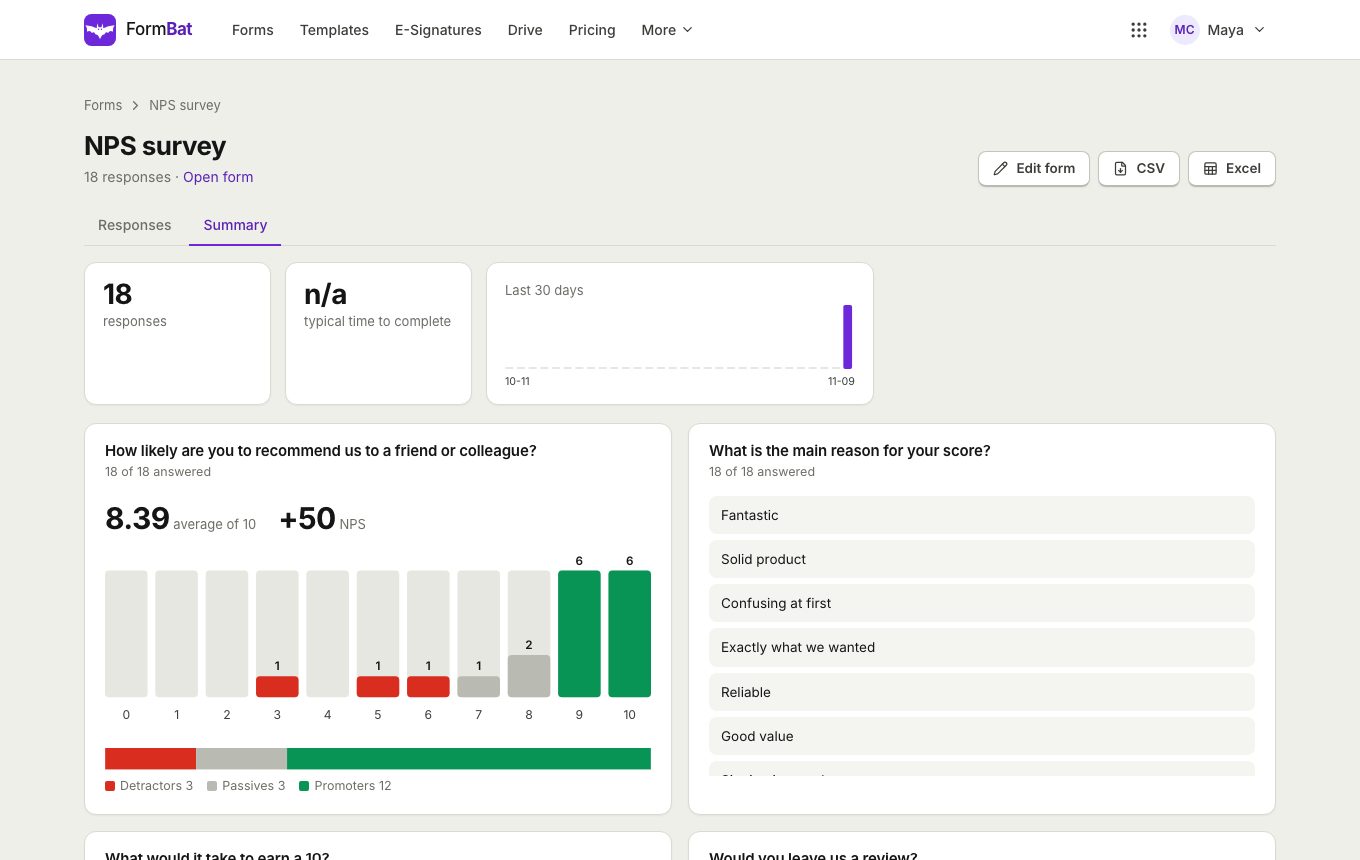
Net Promoter Score, or NPS, is one of the most common ways to measure how customers feel about a product or service. It is popular because it is simple: one question, one number, and a clear way to track it over time. This NPS survey guide explains what the score means, how to calculate NPS by hand, and how to run an NPS survey in FormsBat with a follow up question that changes depending on the score someone gives.
What NPS is
An NPS survey asks one core question:
"How likely are you to recommend us to a friend or colleague?"
People answer on a scale from 0 to 10, where 0 means not at all likely and 10 means extremely likely. Based on their answer, each person falls into one of three groups:
- Promoters answer 9 or 10. They are enthusiastic and likely to recommend you.
- Passives answer 7 or 8. They are satisfied but not excited, and could switch to a competitor.
- Detractors answer 0 to 6. They are unhappy, and may tell others about it.
The score itself ignores passives in the calculation but keeps them in the total. That is what makes NPS different from an average rating.
How to calculate NPS
The formula is:
NPS = percentage of promoters minus percentage of detractors
Step by step:
- Count the total number of responses.
- Count the promoters, the people who answered 9 or 10.
- Count the detractors, the people who answered 0 to 6.
- Divide each count by the total and multiply by 100 to get two percentages.
- Subtract the detractor percentage from the promoter percentage.
The result is a whole number between minus 100 and 100. It is written without a percent sign. A score of 100 means everyone is a promoter. A score of minus 100 means everyone is a detractor.
A worked example
Say 200 customers answered your survey:
| Group | Scores | Responses | Share |
|---|---|---|---|
| Promoters | 9 to 10 | 110 | 55% |
| Passives | 7 to 8 | 50 | 25% |
| Detractors | 0 to 6 | 40 | 20% |
Your NPS is 55 minus 20, which is 35.
Notice that the 50 passives still matter. They are part of the 200 that each percentage is based on. If those 50 people had not answered, your promoter share would be 110 out of 150, about 73%, and your detractor share 40 out of 150, about 27%, giving a score of about 47. That is why it is worth inviting everyone, not only your happiest customers.
Why the follow up question matters
The number tells you how people feel. It does not tell you why. The most useful part of an NPS survey is almost always the open question that comes right after the score.
The trick is to ask a different question depending on the answer:
- To detractors (0 to 6): "We are sorry to hear that. What is the main thing we could do better?"
- To passives (7 or 8): "What would make you more likely to recommend us?"
- To promoters (9 or 10): "Great to hear. What do you like most about us?"
A detractor who is asked "What do you love about us?" is unlikely to answer, and a promoter who is asked "What went wrong?" is confused. Matching the question to the score gets you more answers and better ones.
How to run an NPS survey in FormsBat
- Open the NPS survey template, or go to FormsBat forms and start a blank form.
- Add a linear scale question and set it up as NPS, from 0 to 10, with the labels "Not at all likely" and "Extremely likely". Use the standard wording for the question so your score is comparable over time.
- Add three long text questions for the follow ups: one for detractors, one for passives and one for promoters.
- Add conditional logic to each follow up. Show the detractor question when the score is 6 or less, the passive question when it is 7 or 8, and the promoter question when it is 9 or 10. Each person then sees exactly one follow up.
- Optionally add one or two short questions, such as what they use most, using multiple choice or rating questions. Keep the whole survey under a minute.
- Pick a theme, add your logo and accent colour, and write a short thank you message.
- Preview the form and try each path: answer 3, 7 and 10 and check that the right follow up appears each time.
- Publish and share it.
Where to share your NPS survey
Timing and placement make a big difference to response rates.
- By email after a purchase, a support ticket or a set period of use. Send the link to
/f/your-survey. - On your website or in your app, using the embed, which resizes itself to fit the page.
- In person with a QR code on a receipt, a table card or a screen at the end of an event.
Ask at a moment when the experience is fresh, and do not survey the same people too often. Every few months is plenty for most businesses.
Reading the results
Open the survey's summary view. FormsBat calculates the NPS for the linear scale question and shows it in a summary chart, so you do not have to count promoters and detractors yourself. Other questions get their own charts.
For the follow up answers, open the responses table. You can search the text for words like "price", "support" or "delivery", sort by score to read all your detractors together, and filter by date to compare one month with the next. Export to CSV or Excel if you want to tag themes in a spreadsheet.
A good routine is to read every detractor answer, look for the two or three themes that come up most often, fix one, and then watch whether the score moves in the next round.
Common NPS mistakes
- Treating it as an average. NPS is not the mean score. A mean of 7.5 could be a positive or negative NPS depending on the spread.
- Changing the question. If you reword the question or change the scale, your new scores are no longer comparable with your old ones.
- Only surveying happy customers. If you only send the survey after a five star review, your score will look great and tell you nothing.
- Ignoring passives. They are the easiest group to win over, and the follow up for passives often has the most practical ideas.
- Collecting comments you never read. The number is a headline. The comments are where the work is.
NPS, CSAT and other surveys
NPS measures loyalty over time. If you want to know how a single interaction went, such as a support chat or a delivery, a customer satisfaction survey works better. Try the CSAT survey template, the customer feedback template or the event feedback template.
To learn more about charts, exports and survey reporting, see surveys and analytics or the customer feedback survey page.
Frequently asked questions
What is a good NPS?
Any score above 0 means you have more promoters than detractors. What counts as good depends a lot on your industry and how you ask, so the most useful comparison is your own score over time.
How do I calculate NPS?
Take the percentage of people who answered 9 or 10 and subtract the percentage who answered 0 to 6. People who answered 7 or 8 count in the total but not in either group. The result is a number from minus 100 to 100.
Why is NPS not an average?
Because it only looks at the share of very happy and unhappy people. Two surveys with the same average score can have very different NPS results.
How many people do I need for a reliable NPS?
More is better. With only a handful of responses, one or two people can swing the score a lot, so treat early results as a rough signal and watch the trend.
Does FormsBat calculate NPS for me?
Yes. Use a linear scale question set up as NPS, from 0 to 10, and the summary view calculates the score for you from every response.